From Bathing Machine to Open Promenade: The Changing Seaside Edge
See how the seaside edge shifted from screened bathing access to a shared promenade, and how that change reshaped the boundary between town and water.
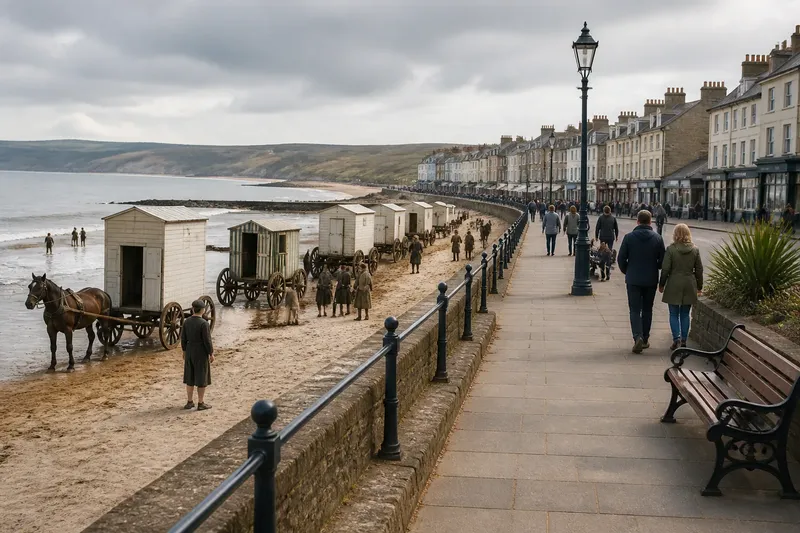
How did the seaside edge change from a place that screened bathers from view to a promenade shared with the town? The bathing machine and the open promenade mark two different ways of arranging access: one made entry to the water private and managed, while the other brought walking, watching and bathing into a more public landscape.
That change was not simply a matter of removing barriers. It altered the line between street and shore, the uses expected of the beach, and the details that made a visit feel orderly. Consider an invented coastal town and follow its edge from a controlled bathing ground to a more open public route.
The bathing machine made the shore a sequence of thresholds
Imagine the invented town of Alderwick, where the high street ends at a sandy beach. In its earlier arrangement, bathing machines stand near the water. These small wheeled huts allow a bather to change in relative privacy and enter the sea without walking across the beach in bathing clothes. A horse or another means of hauling may draw a machine towards the water; the exact arrangement varies by place and period.
For a visitor, the shore is not one continuous public surface. It is a sequence: town, access path, waiting area, machine, water. The machine is both room and transport, a piece of architecture that moves the boundary between land and sea. It offers privacy, but it also makes bathing a managed activity, dependent on an organised service and a designated point of entry.
In Alderwick, the beach remains visible from the street, yet its use is divided. Walkers can approach the sand, but the machinery, changing space and bathing routines give the water’s edge a distinct zone. The line is less a wall than a set of customs and facilities. A visitor understands where bathing begins because the town has marked it through equipment and practice.
The town’s approach determines who reaches the water
The bathing machine focuses attention on the last part of the journey: changing and entering the sea. The route from the town matters just as much. A narrow path, a steep bank or a gate can make the beach feel like a separate destination, even where no formal boundary stands. Access is shaped by the whole approach, not only by the structure nearest the water.
Say Alderwick has a single sloping lane between its shops and the beach, and the lane is partly occupied by carts serving the bathing machines. In this invented situation, the town could clear the route and mark a pedestrian passage. The observable result would be a more legible approach: people on foot could move towards the sand without having to negotiate around the service traffic. The bathing arrangement itself would remain, but its connection to town would change.
This distinction helps explain why an open promenade is more than a path beside the sea. A promenade joins the town to the shore through a continuous public route. It can make looking at the water, strolling and reaching the beach parts of one ordinary outing, rather than separate activities arranged around a bathing service.
The open promenade turns the edge into shared public ground
As seaside towns developed promenades, the public edge could serve people who did not intend to bathe. Walkers, families, vendors and those simply watching the water could occupy the same broad setting. The shore became an address for public life, not only a place for entering the sea. That shift widened the purpose of coastal design.
In Alderwick, the town replaces its narrow final approach with a level promenade running along the beach. The route remains on the landward side of the sand, with open views across the water and several clear ways down to the shore. The change does not remove bathing facilities; it stops them from defining the entire edge. Bathers can reach the beach, while other visitors can remain on the promenade without being treated as incidental.
The promenade also changes what counts as a boundary. A bathing machine provides a strong, local threshold: go inside, change, then emerge near the sea. A promenade establishes a softer and longer threshold. Its parapet, seating, paving or planted margin may separate walking space from beach, but the boundary is experienced along a route rather than at a single doorway. Like a front step shared by a whole street, it gives people a place to pause without requiring them to enter the room.
Public access depends on details as well as openness
An open edge can still be difficult to use. A route that is continuous on a plan may be interrupted by steps, a narrow pinch point, a busy service entrance or a steep descent to the sand. The design question is not merely whether the promenade is open, but how visitors move between its different levels and activities.
In Alderwick, the new promenade runs beside a sea wall. Its broad walking surface is easy to follow, but the beach can be reached only at one end by steps. The town’s next design decision is therefore about connections, not appearance. A suitable accessible route down to the beach, where site conditions allow, would make the edge more usable for people with different mobility needs. Seating placed clear of the main walking line could offer a pause without turning the route into an obstacle course.
Other details also influence how public the shore feels. Clear sightlines help visitors understand where the route goes. Signs can distinguish beach access from service areas without making the whole waterfront read as restricted. Drainage, robust paving and lighting affect comfort and upkeep, while the location of changing facilities can provide privacy without hiding the beach behind a new barrier. The aim is not to make every activity happen in the same spot; it is to let activities coexist without confusing their boundaries.
The old and new edges answer different questions
The bathing machine and the promenade should not be treated as simple opposites. The machine answers a specific question: how can a bather change and reach the water with privacy? The promenade answers a broader one: how can the shoreline work as public space for people with different reasons to visit? In some coastal settings, facilities for privacy remain useful alongside an open route.
What changes is the organising principle. In the machine arrangement, the bathing service sets the rhythm of access. In a promenade arrangement, the public route is the main framework, with bathing and other uses attached to it. That difference can be read in the plan: where the path runs, where people enter the beach, whether a visitor can continue along the shore, and which activities are separated or brought together.
For a designer considering an existing waterfront, the useful question is not whether to preserve every old arrangement or replace it with a contemporary promenade. It is which boundary the place needs. A sheltered changing room may support privacy; a clear, continuous route may improve public movement; a step-free connection may address a practical barrier. The best response can retain one function while changing how it meets the town.
What should a visitor look for in a changing seaside edge?
How did bathing machines control access?
They combined changing space with a means of reaching the water, making bathing a managed sequence rather than an unbroken walk from town to sea. Their position and use helped distinguish the bathing zone from the rest of the beach.
What makes a promenade different from a beach path?
A promenade is usually conceived as a public route and place to linger along the shore, not merely a way down to the sand. Its connection to the town and its accommodation of people who are not bathing are part of its purpose.
Can privacy remain in an open waterfront design?
Yes. Changing facilities can offer privacy while the wider route and views remain public. Their entrances and placement can support discreet use without making the beach feel hidden or divided into an unnecessarily controlled sequence.
What reveals whether the town-water boundary is genuinely accessible?
Look for a route that continues clearly, understandable beach entrances and connections that do not rely solely on steps. Seating, signs and service areas also show whether different uses have been arranged to share the edge without blocking one another.
The boundary is a design decision, not a fixed line
Alderwick’s invented transformation leaves the beach recognisable, but changes how the town meets it. The bathing machine concentrates privacy and access in a movable enclosure; the promenade spreads public movement along the shore. Neither arrangement removes the need for decisions about routes, facilities and the transition between pavement, beach and water.
For anyone reading a coastal place, the seaside edge offers a practical record of those decisions. Notice where a visitor can pause, where a bather can change, how the town reaches the sand and whether the route invites people to continue or quietly sends them back. The change from bathing machine to open promenade is, at heart, a change in who the shoreline is designed to accommodate.