The Nautical Motif Overload: When Coastal Details Compete
Nautical motif overload can make a coastal place feel generic. Learn how to judge anchors, rope and other maritime details against its own character.
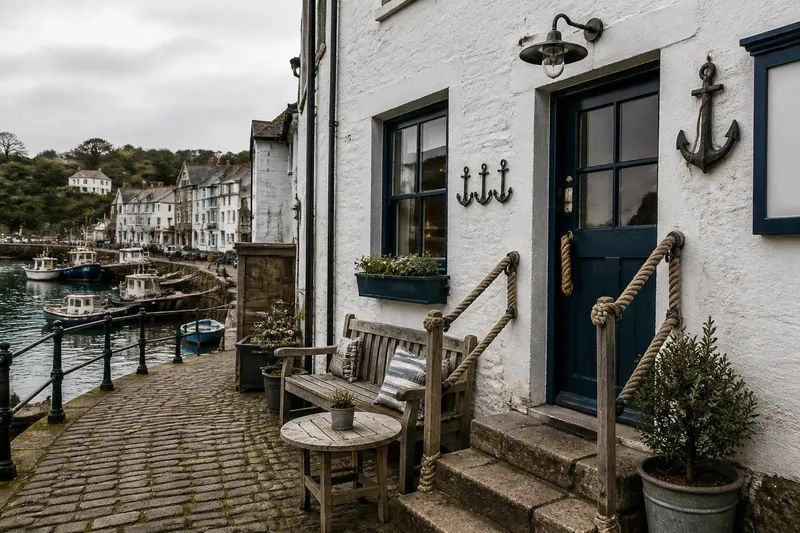
How many anchors does a coastal place need before it stops feeling like itself? Nautical motif overload begins when anchors, ropes and other maritime details compete with the building, shoreline and ordinary life around them. The problem is not that these motifs are always wrong; it is that repetition can turn a specific place into a generic seaside display.
A shell on a door or a rope-wrapped handle may suit a particular setting. Add the same visual language to signs, railings, lamps, furniture and shopfronts, and the details start to crowd one another. A visitor reads “nautical” before noticing whether the place is a working harbour, a quiet bay or a town with its own architectural character.
Nautical motif overload begins with repetition
Maritime motifs carry associations that are easy to recognise. An anchor suggests boats and moorings; rope suggests rigging and practical work; a ship’s wheel points towards navigation. Their clarity is useful, but it also makes them tempting shorthand. A designer can add a familiar symbol without asking what the actual location calls for.
One motif can work as an accent. Repeating it across unrelated surfaces changes its role: it becomes a theme that explains the place in advance, leaving less room for the place to speak for itself. The effect resembles putting the same label on every drawer in a cupboard. Nothing is hard to identify, but the arrangement is doing more announcing than it needs to.
Repetition is not simply a matter of counting anchors. A cluster of different symbols can still feel busy if they share the same bold scale, colour and placement. Conversely, a motif repeated quietly in a coordinated set of signs may read as a clear identity rather than decoration piled on decoration.
Begin with what the setting already says
Before assessing decorative choices, identify the features a visitor can observe without them. These might include the direction of a harbour entrance, a sheltered lane, the rhythm of nearby windows, local stone, a public slipway or the view between buildings. The most convincing coastal details often respond to such specifics rather than simply naming the sea.
That does not mean every ornament must have a practical purpose. A painted fish can be playful, and a rope detail may recall a local trade. The useful question is whether a choice adds something to this particular place or could be moved unchanged to any resort and still make the same sense.
Material and form can carry a coastal quality without literal symbols. A timber threshold worn by traffic, a salt-tolerant finish chosen for exposure or a simple rail aligned with a view can make the setting legible through use and proportion. These choices are not automatically better; they are simply more connected to how a place works.
Assess decorative choices in context
Look at a motif alongside the elements around it, not as a product sample in isolation. A rope handrail may sit comfortably beside a plain timber door, then feel forced when it appears again on a sign, a lamp and a bench. The cumulative effect is what matters.
- Identify the motif: Name what is being repeated, including anchors, shells, ropes, fish, wheels or painted wave patterns.
- Trace its appearances: Note where it recurs, such as entrances, signs, paving, furniture and fittings.
- Check the local link: Ask whether the form relates to an observable feature, use or material of this site.
- Compare visual weight: Notice whether colour, scale, contrast and placement make the motif dominate its surroundings.
- Consider daily use: Ask whether the detail helps people understand, use or enjoy the space, or mainly repeats its theme.
- Choose what to keep: Retain the instance with the clearest local or practical connection, and reconsider the rest.
Say a small harbour café has rope around its door handle, a rope-patterned sign, anchor-shaped coat hooks and a large painted ship’s wheel on the wall. Imagine its owner leaves the handle and hooks, but replaces the sign with clear lettering and removes the wheel. The expected observable result is fewer competing signals: the entrance remains recognisably maritime, while the café’s actual harbour setting and everyday use have more room to register.
Scale, placement and material change the effect
A small motif near an entrance can read as a personal detail; a large one above the façade can become the building’s main identity. Placement matters because people tend to notice entrances, corners and repeated elements as they move through a space. A motif in every sightline has little chance to remain an accent.
Material also alters tone. A plain metal anchor used as a modest sign fitting may feel quite different from a glossy, oversized anchor attached to a weathered wall. The first can relate to the building’s working character; the second may read as a prop. Neither judgement is universal, but the relationship between finish, scale and surrounding fabric is visible.
Colour can intensify repetition. If every maritime symbol uses the same bright blue and white, the motifs gather into one strong visual block. A quieter palette may allow one symbol to stand out without turning every surface into a reminder of the theme.
Which coastal motifs earn their place?
How can I tell whether an anchor detail suits the building?
Look for a connection to the building’s use, setting or existing materials, rather than relying on the anchor’s general maritime association. If it draws attention away from the entrance or repeats a symbol already prominent nearby, its contribution may be slight.
Can rope be used without making a place look themed?
Yes, when its presence is limited and appropriate to the setting or the object it finishes. A single rope detail can feel specific; rope-patterned trim repeated across unrelated fittings can make the same place feel staged.
Do coastal interiors need maritime ornaments?
No. Light, views, local materials and the way people use a room can establish a coastal character without anchors or shells. An ornament can still belong, but it need not carry the whole identity of the space.
What should be removed first when the details feel crowded?
Start with the most prominent motif that has the weakest connection to the setting or daily use. Removing that one element can clarify what the remaining details are doing before anyone makes broader changes.
Let the place remain more specific than its theme
A restrained approach is not the same as a ban on maritime decoration. It means choosing details that respond to a site and allowing them enough space to be noticed. When deciding whether a coastal detail belongs, judge its local connection, visual weight and role in daily use; nautical motif overload often becomes apparent once those questions are asked.
The most useful test is whether the place would still be recognisable if its decorative symbols were removed. If the answer is yes, the setting has an identity of its own. Any maritime motif that remains can then support that identity, rather than being asked to stand in for it.