A First Visit to a Coastal Museum: Read One Building from Outside In
A first visit to a coastal museum becomes easier to read when you follow its outline, materials, entrance and setting in a simple looking route.
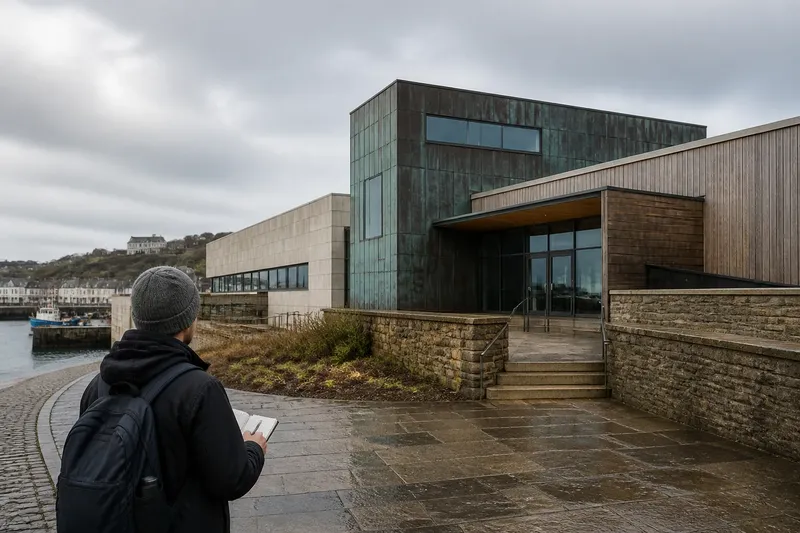
At a coastal museum, the entrance can be visible long before the building explains itself. On a first visit, the useful question is not simply where to go in, but what the building is doing with its exposed site. A coastal museum building is easier to read if you begin with its outline, then look at its materials and entrance, and only afterwards connect those clues to the shore around it.
Begin with the whole outline before choosing a viewpoint
The first common snag is getting pulled towards a striking detail too soon: a tower, a bright doorway or a roofline that seems to mimic a boat. That detail may be memorable, but it cannot tell you how the building meets the ground or whether its largest spaces face the sea, the town or neither.
Walk to a place where you can see most of the building without blocking paths or standing in a vehicle entrance. Look at its overall height, the direction of the longest wall, the roof profile and the way different parts join. A low wing beside a taller block, for instance, may suggest that the museum is arranged around more than one kind of space; treat that as a question, not an answer.
If a wall, dune or neighbouring building hides part of the outline, do not fill in the gap from imagination. Shift along the public route and see whether another view clarifies the shape. Like turning a mug to find its handle, changing your position can make an awkward form legible without requiring a clever theory.
Read the materials as responses to exposure
A second problem is mistaking visible weathering for a design message. Salt, wind-driven rain and bright light can make surfaces change unevenly, while a dark patch may be shade or damp rather than a deliberate colour choice.
Compare materials in different positions: a sheltered recess, an exposed corner and the area near the entrance. Notice whether the surface is rough or smooth, whether joints are prominent, and whether one material stops where another begins. Brick, stone, timber, painted metal and glass each make different edges and reflections, but their appearance alone does not disclose why the designer chose them.
Try to separate what you can see from what you infer. You might observe that a metal panel has a dull finish and that a sheltered section looks less marked; you cannot conclude from that alone how the panel was specified or how it will age. If a material question matters to your visit, the museum’s own interpretation or published building information may supply context that the façade cannot.
Do not let the entrance become the whole building
Visitors often read the entrance as a complete explanation: a glazed lobby must mean openness, a heavy door must mean protection, a ramp must be an afterthought. Each impression may be wrong. An entrance is a working threshold, shaped by access, visitor flow and the practical business of keeping the interior usable.
Look at how the approach meets the door. Is the route direct or does it turn? Does a canopy, recess or change in paving mark the transition? Notice whether the entrance is easy to identify from the public path and whether its position appears to connect with the building’s broader orientation.
Then enter, if the museum is open, and look back towards the exterior. The view can reveal whether the doorway frames the landscape, hides it or makes the town more visible than the water. Do not assume that a dramatic opening is intended as a picture window; it may simply be where circulation and access work best.
Connect the building to its setting without guessing
The next snag is treating “coastal” as a complete explanation. A museum beside the sea might face a harbour, a town street, a sheltered inlet or a managed path inland. The shoreline is not a single design brief, and a building’s orientation may answer several local conditions at once.
From the museum’s public approaches, identify what lies around it: water, street, slope, harbour structures, open ground or other buildings. Note which directions are prominent and which are screened. Then ask what the building seems to acknowledge. A low roof beside an open horizon may sit quietly in the view, while a taller entrance block may be easier to spot from the street.
Say you arrive at an invented museum where the main façade faces a car park, while a narrow side path opens towards the harbour. You could first record that the entrance is street-facing, then follow the public path to see whether the harbour view appears from the building’s edge. The expected observable result is a clearer account of how visitors approach the museum and where the setting becomes visible, not a claim about the architect’s intention.
What should you look for on a first visit?
Should I start at the sea-facing side?
Start where you can safely and legally view the building as a whole, not automatically at the water’s edge. The most informative first view may be from a street, path or courtyard that shows the outline and the main approach together.
How can I tell whether weathering is intentional?
You usually cannot tell from appearance alone, especially where salt and rain affect surfaces unevenly. Describe the visible change first, then look for museum interpretation or building information before assigning a design purpose.
What if the museum is closed?
You can still follow the public routes around it and observe the outline, materials, entrance and relationship to nearby streets or shore. Keep to accessible public areas and avoid treating service yards, barriers or closed paths as invitations to get a better view.
Should I take photographs or make notes?
Either can help, provided photography is permitted and does not obstruct other visitors. A brief note about viewpoint, surface and direction is often more useful later than a set of images with no record of where you stood.
Finish by comparing the approach with the view back
Before leaving, return mentally to the first place from which you saw the building. Ask whether your understanding changed after noticing the entrance, its materials and the surrounding routes. If the answer is no, that is still useful: the building may present a consistent face, or the site may offer few public viewpoints.
A first visit to a coastal museum need not produce a verdict on whether the building succeeds. The more reliable result is a short, grounded description: what its outline does, where materials change, how visitors enter and which parts of the setting the building acknowledges. Keep observation and interpretation separate, and the next visit—inside or outside—will have something solid to build on.